

Edge + GenAI: The Architecture Behind Instant Digital Experiences
Discover how GenAI at the edge unlocks real time digital experiences with low latency intelligence, responsive architecture, and next level customer engagement.
 ·
·
Join the DZone community and get the full member experience.
Join For Free
Real time digital experiences are no longer dictated by cloud strategy alone. They’re being shaped at the edge, where decisions happen in real time, not after-the-fact reporting.
In the moments that matter, milliseconds make or break the experience. They decide whether payments clear, checkouts stall, issues get contained early, or customers drop off entirely.
That is why the momentum is unmistakable. GenAI is migrating toward the environments where signals originate and decisions must be made instantly. Instead of using edge infrastructure as a simple collection point that funnels data upward, more organizations are executing inference locally, shaping responses, decisions, recommendations, and actions right where they’re needed.
This is not a novelty hunting for relevance. It is an architectural pattern aligned with how modern systems truly behave: distributed, time-sensitive, and expected to react immediately.
Why Edge + GenAI Is Showing Up in Production
User expectations have changed because the best experiences feel instant, predictive, and personal. People don’t compare your product to your direct competitors anymore. They compare it to the fastest experience they had last week, whether it came from a shopping app, a payment platform, or a streaming interface.
Meanwhile, enterprise systems are no longer concentrated in a single data center or region. Work now occurs in warehouses and storefronts, branches and vehicles, factory floors and field environments where connectivity can be weak, inconsistent, or absent. In these conditions, cloud-only intelligence becomes less dependable, especially when choices must be made right now.
Gartner has projected a sharp rise in machine learning adoption at the edge by 2026 compared to what it looked like in 2022. The implication is straightforward: the edge has stopped being merely the birthplace of data. It is evolving into the runtime of intelligence.
Why Cloud-First AI Hits a Wall in Real Time Systems
Traditional enterprise AI has mostly followed a cloud-first approach. Data is produced at the source, shipped upstream to central infrastructure, processed by models running in the cloud, and then sent back down as a response or recommendation. That architecture works when timing isn’t critical.
But real time systems do not come with that luxury. Latency margins shrink quickly when you’re shaping customer journeys, safety-critical processes, or operations where delays are expensive. Every network round trip becomes a recurring toll. And when connectivity weakens, performance collapses along with it.
That’s the structural vulnerability. Centralized inference makes responsiveness inseparable from network quality. In live environments, that is a brittle foundation for any experience that must stay intact under pressure.
Edge Intelligence Changes How Decisions Flow
Edge intelligence flips the model. Instead of sending everything to the cloud first, it processes and acts on data locally, then forwards only what’s necessary. When teams do this well, the edge stops being a passive layer and becomes an active execution surface. It can evaluate events, interpret signals, and trigger actions immediately. The cloud still has a major role, but it becomes the coordinator, not the gatekeeper.
GenAI amplifies this shift.
Because when GenAI runs at the edge, it does more than score data or classify outcomes. It can compose explanations, produce summaries, generate troubleshooting guidance, recommend next moves, and deliver real time assistance based on the precise situation unfolding in front of it. That’s how systems begin to feel conversational and adaptive, not because they’re trying to impersonate chatbots, but because they respond with context.
This is the moment where experiences move from merely reactive to genuinely responsive.
Why This Matters Beyond Architecture Diagrams
GenAI at the edge isn’t simply an engineering optimization. It shapes outcomes teams care about. When latency drops, experiences feel smoother. When decisions happen locally, systems become more resilient. When intelligence runs closer to where work happens, the gap between insight and action shrinks dramatically.
And that translates into outcomes that matter.
Revenue climbs because fewer customer journeys fracture midstream and support arrives when it’s still salvageable. Costs decline because you stop routing every request through centralized compute and bandwidth-heavy pipelines. Risk falls because sensitive information stays nearer to its origin, and the operation can continue even during network disruption.
Six Shifts You Make When You Build Edge-First GenAI Systems
Teams don’t “roll out” edge GenAI like a new feature toggle. They grow into it by evolving the way they design, package, and govern intelligence across distributed environments.
They move through a series of shifts as they start building systems that have to work under real constraints.
1) Latency Stops Being a Backend Metric
Latency becomes a product mandate. Not a post-launch patch, but a constraint you architect around from the beginning.
Real time experiences are shaped by the gap between a signal and a response. Even tiny delays can inject friction, especially when users are already one poor moment away from abandoning the flow. When inference happens locally, response feels immediate. The system feels present, not remote.
2) Context Becomes the Differentiator
Centralized AI can be statistically strong and still feel bland, because it observes the world from afar.
Edge GenAI can tap richer context: device conditions, session behavior, environmental signals, and operational state. That context is what makes outputs feel specific rather than generic. It also strengthens privacy posture because intelligence can be produced locally, instead of exporting raw sensitive signals upstream.
3) Pilots Turn into Deployable Systems
Many GenAI programs stall because scaling them is harder than proving them.
Often it isn’t the model that fails. It’s the deployment reality that never materializes. Distributed systems require consistent packaging, predictable upgrade paths, safe rollbacks, deep monitoring, and runtime controls that can survive messy environments. When edge GenAI is treated as a platform capability rather than a standalone experiment, deployments become repeatable across hundreds or thousands of sites.
4) Data Movement Stops Being Default
For years, enterprises assumed the best strategy was collecting everything. In practice, that strategy drives up cost and introduces compliance risk.
Edge-first GenAI supports a more disciplined model. You process locally, extract high-value signals, and forward only what improves decision-making or meets governance requirements. This reduces noise, cuts bandwidth, and aligns data movement with real outcomes instead of “just in case” pipelines.
5) Journeys Become Adaptive, Not Scripted
Traditional digital journeys are fixed. They follow defined steps regardless of what the user is actually doing.
With edge GenAI, the system can adjust in real time, responding to micro-signals before frustration accumulates. Instead of forcing everyone down the same linear route, the experience reshapes itself while the user is still moving through it.
That shift is subtle, but it is exactly how intelligence becomes noticeable in a way users actually feel.
6) Autonomy Doesn’t Mean Loss of Control
A common concern is that pushing GenAI outward creates chaos. In practice, well-designed guardrails usually produce the opposite.
Central teams can define policy, constraints, monitoring, and governance rules, while edge nodes operate autonomously within those boundaries. That delivers speed at the point of action while keeping the system observable, compliant, and stable at enterprise scale.
What’s Driving Adoption: ROI, Operations, and Regulation
Organizations are not investing in edge GenAI purely because it feels exciting. They’re investing because it removes bottlenecks that slow everything else. Forrester has indicated that many AI decision-makers are increasing investment in generative AI, signaling a broader transition from experimentation to operationalization.
Edge GenAI adoption tends to accelerate fastest where the payoff is immediate: customer journeys that demand instant responsiveness, operations where downtime carries a real price tag, and regulated industries where data cannot casually leave local boundaries without escalating risk.
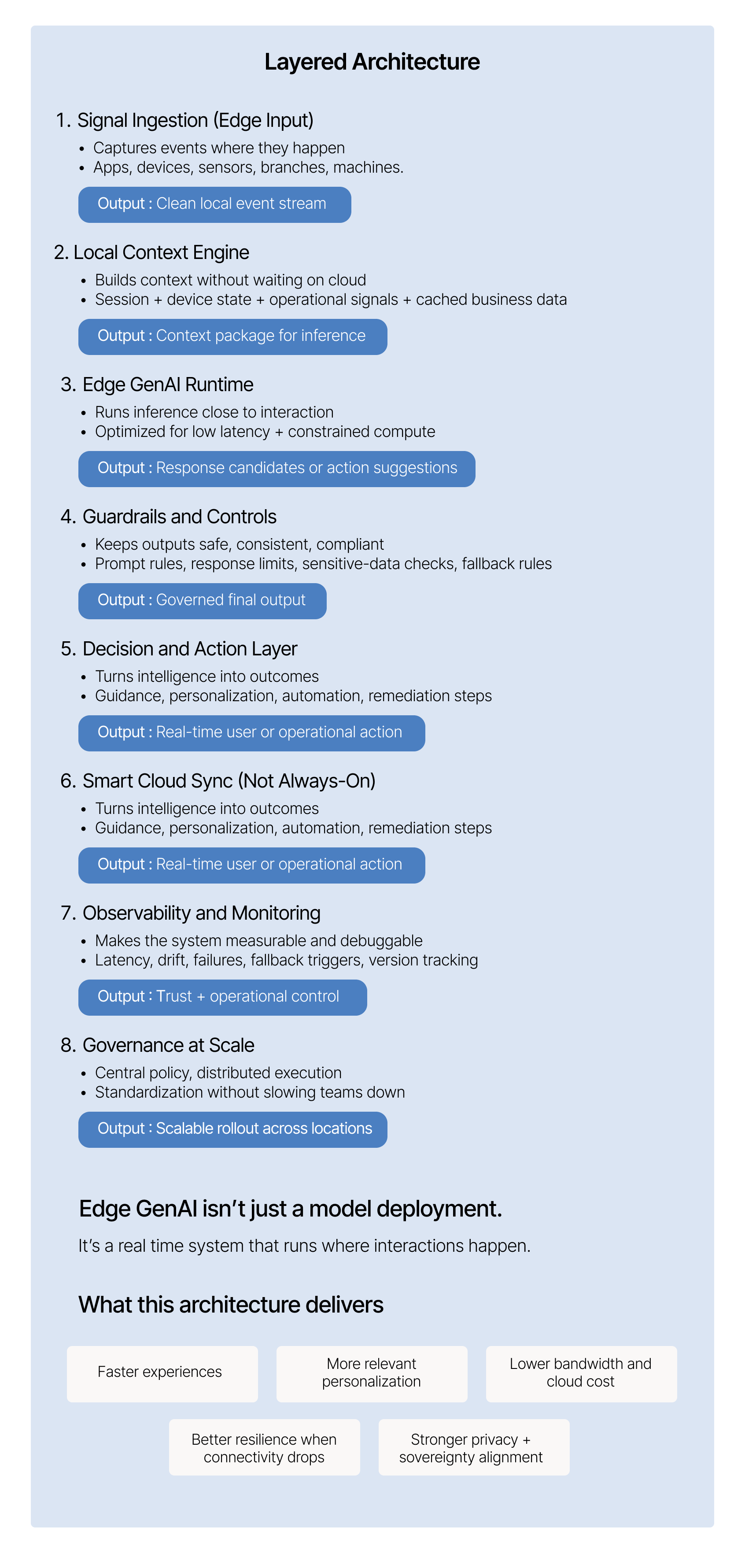
The Real Blueprint Isn’t a Model. It’s a System.
When you build GenAI at the edge, inference is rarely the hardest part.
The real complexity surrounds inference: event ingestion, context assembly, output control, caching, synchronization that adapts to connectivity, fallback behavior, monitoring, and auditability. You need governance that scales across endpoints without affecting the delivery speed.
That’s what turns GenAI from a demo into a dependable digital experience layer.
Closing Thought: The Enterprise That Responds in Real Time Wins
The future belongs to organizations that treat the edge as core infrastructure, not an add-on. When edge meets GenAI, enterprises unlock real time intelligence, resilience, scale, and better user experiences without losing governance or cost control. The fast movers won’t just migrate workloads, they’ll raise the bar for speed and context.
Edge GenAI creates systems that don’t just record what happened and deliver reports later. They respond while it’s unfolding. That is the new bar. And that’s how real time digital experiences are built.
Opinions expressed by DZone contributors are their own.
Comments